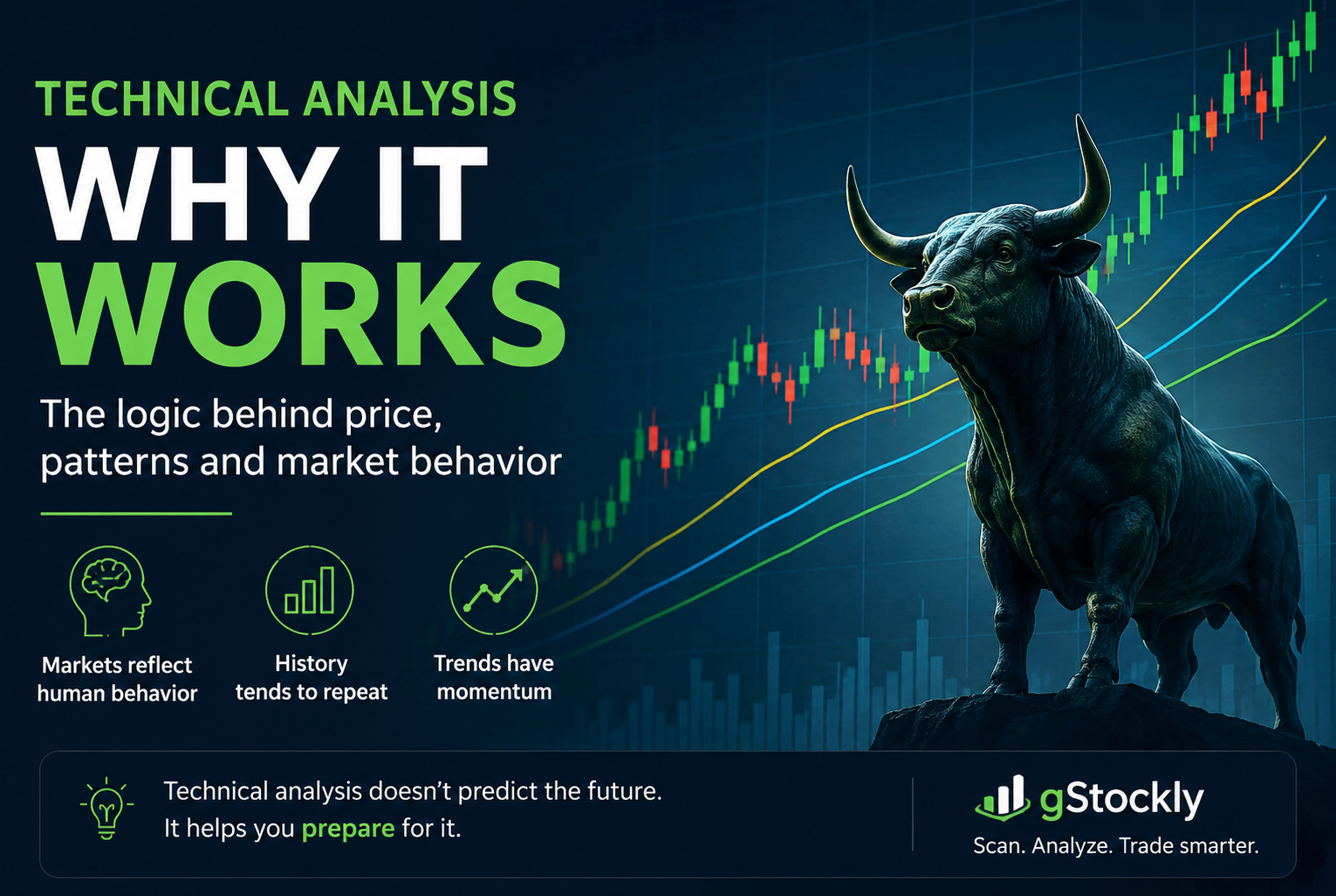
Why Technical Analysis Works: Markets Repeat Human Behavior
Many beginners think technical analysis is some kind of magic.
Others believe charts are random.
But if charts were truly random, why do the same patterns appear again and again — across decades, markets, and even different asset classes?
Technical analysis works because markets are driven by human behavior. And human behavior repeats.
The Market Is Not Just Numbers
When you open a stock chart, you are not looking at lines.
You are looking at fear, greed, hesitation, optimism, panic, institutional accumulation, and emotional decisions made by millions of people.
Every candle on a chart represents human behavior. That is why recognizable patterns appear repeatedly.
Why Patterns Repeat
Imagine a stock that reaches $100 several times but fails to break above it. Traders begin remembering that level:
- Some sell near $100
- Some wait for a breakout
- Some place stop orders above it
- Institutions monitor liquidity around it
Over time, that price becomes psychologically important. This is exactly how resistance levels are formed.
Support and Resistance Are Psychology
Support and resistance are not magical invisible lines. They are areas where buyers and sellers strongly reacted in the past. Traders remember profit and pain. The market becomes a map of collective emotions.
Why Moving Averages Work
Millions of traders monitor the same moving averages:
- 20 EMA
- 50 SMA
- 200 SMA
Because so many market participants watch the same levels, reactions often happen repeatedly. The chart reflects collective expectations.
Markets Move in Cycles
Markets rarely move in straight lines forever. They usually move through phases:
- Accumulation
- Expansion
- Distribution
- Decline
Strong breakouts are often preceded by tight consolidations, low volatility, increasing volume, and repeated support reactions.
Technical Analysis Is About Probabilities
Technical analysis does not predict the future. It simply helps identify situations where probabilities may be favorable. The goal is not perfection — the goal is improving decision quality.
The Real Problem: Too Many Charts
The U.S. market alone contains thousands of stocks. No trader can manually monitor everything efficiently. Every day, some stocks bounce from moving averages, break resistance levels, build accumulation structures, form double bottoms, or show unusual volume activity.
Finding these setups manually becomes almost impossible at scale. That is why stock scanners exist.